
How to Manage IT Vendor Relationships

If you manage IT vendor relationships at a bank or healthcare organization, there’s a good chance at least one of those relationships isn’t performing the way you’d like. And, you’re not alone.
For example, the ABA Core Platform Survey found that banks rated their core IT providers 2.78 out of 5. Not great.
When those same providers rated themselves, they gave themselves a 4.31. On the same relationship.
That’s a significant gap, and it’s not unique to banking.
In my experience working with financial institutions, healthcare organizations, and other sectors for more than 25 years, the story is similar across industries. The diagram below shows how this typically plays out.
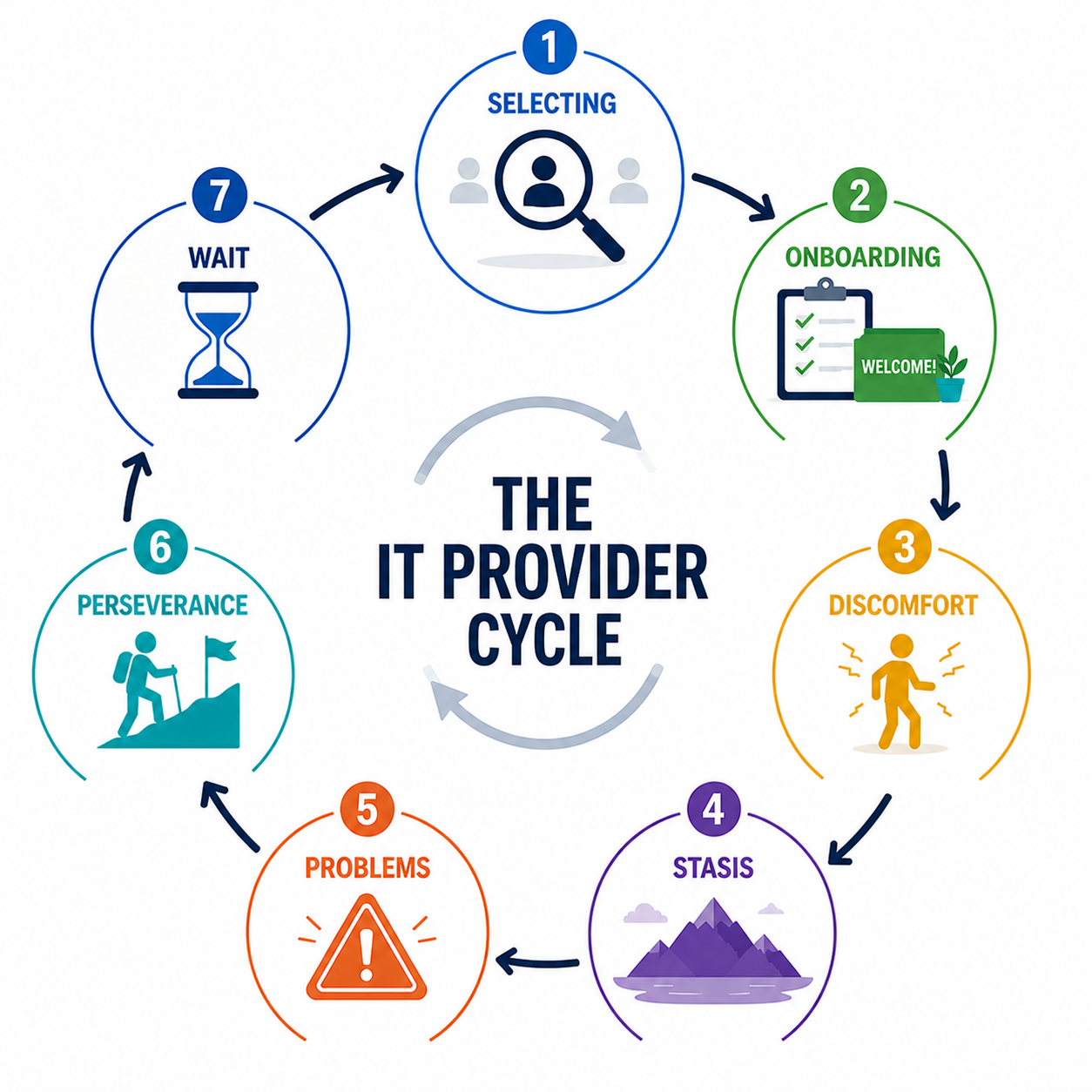
Here’s what I’ve come to believe: the quality of your IT provider relationships has less to do with which providers you choose and more to do with how you manage them.
That’s actually good news, because it means you have more control than you might think.
A Framework for Better IT Vendor Relationship Management
1. Define Success Before Selecting an IT Vendor
Most organizations go through a thorough vendor selection process, then start the engagement without ever clearly defining what they need.
What does good look like six months in?
What systems are truly critical to your operation?
What would it cost you if they were unavailable?
Get alignment on these questions internally, write the answers down, and share them with your provider before work begins.
It becomes the foundation for every conversation that follows. For organizations in regulated industries, this also supports FFIEC vendor management requirements around documented third-party oversight.
2. Onboard IT Vendors Like You Onboard New Hires
When you bring on an employee, you don’t hand them a badge and say “figure it out.” You give them a clear role, a point of contact, expectations, and benchmarks.
Your IT providers deserve the same structure.
Designate someone internally who owns the relationship and is accountable for how it performs. Define how communication works, how decisions get made, and how problems get escalated.
Most of the friction that develops in IT vendor relationships can be traced back to an onboarding that never set clear expectations on either side.
3. Continuously Invest in the IT Vendor Relationship
This is where most relationships quietly fall apart. Not from one big failure, but from gradual drift. Regular check-ins go away. Nobody asks how things are going until something breaks.
If you want a true partner rather than a vendor, you have to treat the relationship like one.
Have conversations that aren’t about a ticket or an invoice.
Ask your providers what they need from you to do their jobs better.
Give them feedback, both when things go wrong and when things go right.
Keep them informed about what’s coming, whether that’s an upcoming exam, a system change, or a new regulatory requirement.
Better IT Vendor Management Starts with Intention
None of this requires a major overhaul of how you operate. Organizations that manage their IT provider relationships this way consistently get better responsiveness, better results, and better value, often from the same providers that others find frustrating.
You don’t need a new vendor. You need a new approach.
Is Your IT Provider Relationship Working as Hard as You Are?
The SERO Group works exclusively with SQL Server environments in banking and healthcare. We’ve seen firsthand how the right relationship structure changes what’s possible.
If you’re spending more time managing vendor friction than getting value from your IT partners, let’s talk.
Schedule a free discovery call and let’s take a look at your environment together.
Recent Comments