

SQL Server Maturity Curve: How Banks Move from Reactive Risk to Strategic Advantage

When I talk with companies, whether they be community banks or healthcare companies, about their SQL Server environments, I find that most aren’t intentionally and proactively managing their SQL Server environment–they’re reacting to it. Things run fine until they don’t. Then, suddenly, IT teams are dealing with performance issues, failed backups, or questions from auditors that need answers.
A reactive approach may get you through the day, but it doesn’t build long-term stability, security, or confidence.
What is the SQL Server Maturity Curve?
Over the years, we’ve found that every SQL Server environment naturally falls somewhere along a maturity curve. Understanding where your SQL Server environment is today and where you want it to be helps you move from firefighting to foresight. SQL Server maturity can be best understood in four stages: reactive, managed, optimized, and strategic.
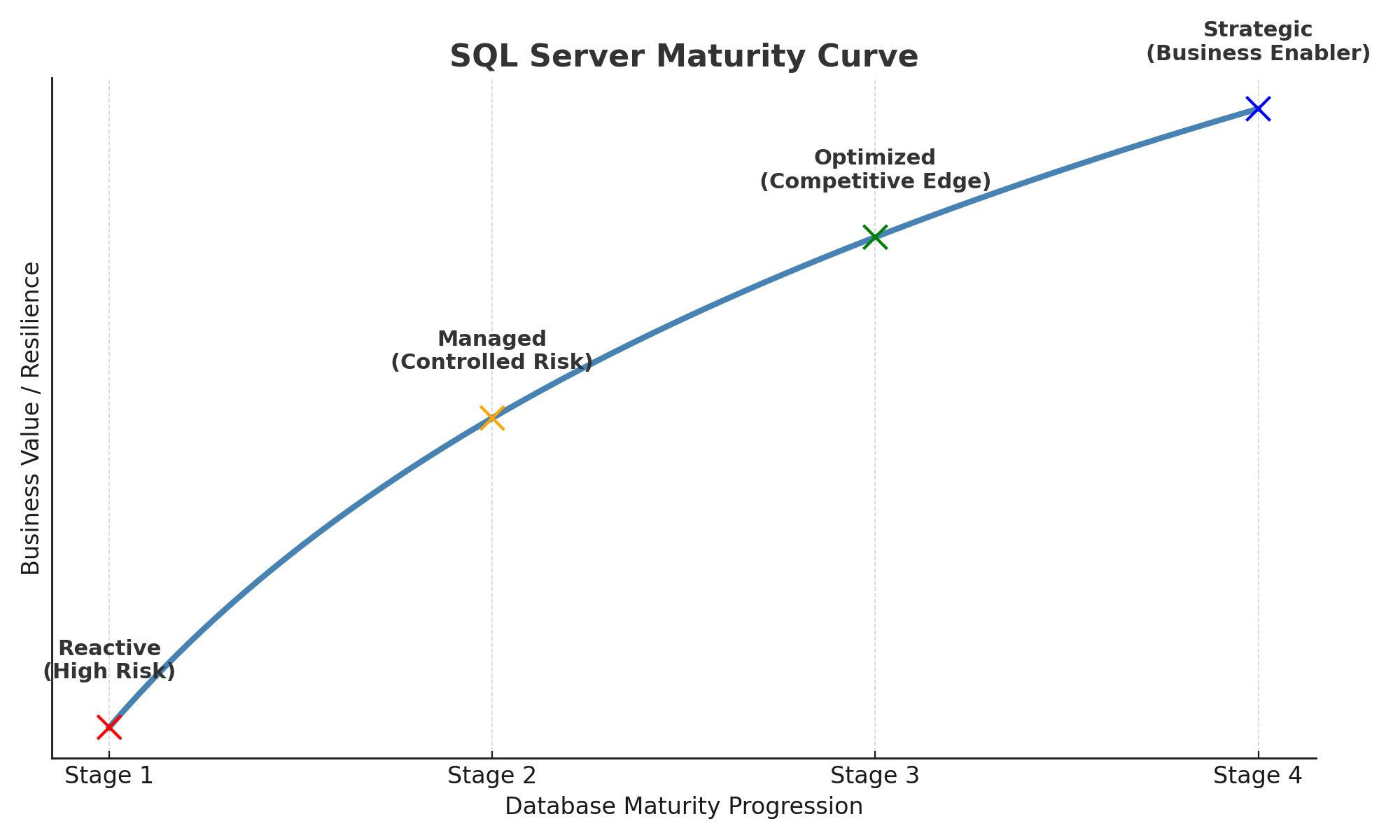
Let’s look at each stage.
1. Reactive: Firefighting
At the lowest level of maturity, we have what we call the reactive stage. This is where SQL Server environments are managed more in a ‘break/fix’ mode. Something goes wrong—an outage, a performance issue, maybe even a regulatory problem—and the team jumps in to fix it. Since the problem usually catches them by surprise, they then have to spend time figuring out how to address the issue before they can start to fix it.
Banks in this stage tend to rely heavily on manual processes and have very little automation in place. There might be some monitoring, but it’s often not tailored to SQL Server and effectively too generic (maybe something like SolarWinds Orion). So, leaders don’t have a clear picture of what’s healthy, what’s risky, or what’s about to break.
A second indicator for this stage is an environment where no one person is truly accountable for SQL Server. It’s a shared responsibility, which really means no one’s watching it closely. It’s just one of many systems all lumped in together. In these environments, small problems slip through the cracks until they turn into something big.
A third indication is the assumption that the vendor or core provider is handling all necessary SQL Server maintenance. In reality, they’re not watching it nearly as closely as the bank thinks they are.
From a business standpoint, this leads to high operational costs, more regulatory findings, and frustrated employees and customers when things go down.
Most of the SQL-related budget at this stage goes toward putting out fires instead of preventing them. Unfortunately, this is still where a lot of community banks find themselves today—operating in a reactive state, vulnerable to risk, and always one incident away from disruption.
2. Managed: Gaining Control
The next stage up in the curve is the managed stage. In this stage banks start putting some structure in place.
Backups are running consistently. And I know what you might be thinking: ‘Of course they are.’ But you’d be surprised how often we hear that, only to find something very different once we dig in during an SQL Health Check.
Monitoring is usually turned on so the team gets alerted before things get out of hand, and patching is scheduled instead of done haphazardly.
You’ve probably heard the phrase people, processes, and technology. At this stage, banks are making solid progress on two of those: processes and technology. And there’s usually someone in IT who’s been given responsibility for SQL Server, though it’s often just one of the many things they take care of.
But the results are noticeable. Incidents are happening less often, performance is steadier, and compliance is easier to manage. There’s even some separation of duties starting to take shape.
Here, most of the SQL-related budget is still going toward maintenance, but now, instead of pure firefighting, a little bit of that time and money is shifting toward planning and improvement.
So the managed stage is a big step forward. Things are more stable, there are fewer surprises, and the environment is definitely safer. But it’s still not efficient—and it’s not yet resilient. That’s usually when the question shifts from ‘Are we stable?’ to ‘How can we do this better?’
3. Optimized: Running Proactively
Third is the optimized stage; things start to look and feel different. We’re no longer spending most of our time just keeping the lights on; the focus shifts from maintenance to efficiency.
Routine tasks like backups and testing the backups, patching, and monitoring are automated and standardized across the SQL Server environment. The team’s not reinventing the wheel on every server anymore. Builds are standardized and perhaps even automated.
Performance is managed proactively—indexes, queries, and resource usage are being reviewed on a regular basis. The bank finally has real visibility into capacity, performance trends, and risks over time.
And all that optimization pays off literally.
At this stage, banks start saving real money. They’re doing proactive performance tuning, right-sizing their environments, and consolidating where it makes sense. That means fewer servers, lower licensing costs, and less wasted hardware.
We worked with one client who was able to save about $2,000 a month—$24,000 a year—on just one of their Azure SQL Servers, simply by tuning and optimizing the setup.
And another bank we work with was able to cut their SQL footprint in half through consolidation and decommissioning efforts. That saves on licensing costs, management costs, etc.
But it’s not just about cost savings. This is also where security gets stronger. Misconfigurations get closed off, permissions are tightened, and the environment starts aligning with best practices like the CIS benchmarks and the principle of least privilege.
The payoff is easy to see. Customers experience faster, more reliable systems. Inside the bank, IT teams aren’t scrambling to fix the latest outage—they’re staying ahead of it. They identify and resolve issues before they impact operations or audits. SQL Server becomes a reliable foundation that actively supports business goals.
4. Strategic: Turning Data into Advantage
In the final stage, the strategic stage, SQL Server isn’t just stable or secure; it’s resilient by design.
High availability is built in. Disaster recovery plans aren’t just written; they’re tested and refined. Security is strong and consistent across the environment, and compliance isn’t something the team scrambles to prove once a year; it’s woven into daily operation.
Auditing and monitoring tools are in place. There’s clear separation of duties. And reporting infrastructure is mature enough to shift workloads where they make the most sense.
But what really sets this stage apart is how SQL Server starts to enable the business.
At this point, it’s not just about avoiding risk; it’s about driving strategy.
Data becomes a competitive advantage. Executives have access to real-time insights through analytics and reporting. They can spot trends, understand customer behavior, and make better decisions—faster.
And IT? It’s no longer seen as a cost center. It’s a business enabler—helping drive efficiency, innovation, and growth.
Moving Up the Curve
Wherever your institution is today, the goal isn’t perfection overnight. It’s steady progress. Moving even one stage up the maturity curve can dramatically reduce risk, improve audit readiness, and free up your team to focus on higher-value initiatives.
The key is to be intentional, to assess, document, and continually refine your SQL Server management practices.
Because in business, in banking, and in healthcare, SQL Server maturity isn’t just an IT milestone; it’s a business advantage.
Further Resources
- Curious where your environment stands today? We’ve created a short SQL Server Maturity Checklist to help you identify which stage your organization is in and where to focus next. It’s a quick, practical way to assess your current practices and start planning your path forward. Download the SQL Server Maturity Checklist to see where you stand and how to move from risk to advantage.
- For a deeper dive on this subject, you can watch our free, on-demand webinar, “Navigating the SQL Server Maturity Curve,” on YouTube.
Want to work with The SERO Group?
If your SQL Server environment feels more reactive than strategic, or if you’re ready to strengthen reliability, improve security, and become more audit-ready, we can help.
We specialize in helping institutions move up the SQL Server maturity curve with proven processes and a proactive approach. Let’s start a conversation about where you are today and where you want to be. Schedule a brief call with us today.
Recent Comments